
We have gathered a list of sources on the topic of gender, sexuality, transnational spaces, and military service in Korea. In addition, we have created a bibliography on historiographical sources particularly focused on oral history research. These sources have been available for educational purposes for GNDR 4690 course. If you are an author here and would like your link removed, please let me know!
Gender and Sexuality in Korea:
Alexander, E. (April 2021). Seoul’s gay districts: Space, place, and identity. (Publication No. N/A). [Master’s thesis, The University of British Columbia].
Keywords: oral history, interviews, gay, men, space, place, Seoul, Jongno, Itaewon
This thesis focuses on two queer districts in Korea: Jongno and Itaewon, and includes excerpts from 15 interviews with gay men on their interactions with these spaces. In particular, the author focuses on the relationship between identity and space, and compares the interaction with queer meetups in real life with digital spaces like dating apps. The essay offers interesting insight into how Western articulations of queerness, including language or processes like “coming out” have been projected onto Korea where they are less important due to heteronormativity. Gay districts, therefore, become spaces where queer people can engage publicly with queerness. Gay men in Korea must negotiate transnational spaces within transnational constructions of queerness despite being Korean men who date Korean men. This thesis serves as the longest single study on queerness in Korea, especially one focused on the relationship between identity and place which is key to my research.
Arnold, M. (December 2016). Queer Korea: Identity, tradition, and activism. (Publication No. N/A). [Master’s thesis, Duke University].
Keywords: oral history, interviews, socializing, activism, identity
Arnold argues that queer Koreans are required to abide by a “surreal social compact” that requires that they participate in a precarious game of “hide and seek” with their identity in order to participate fully in society. This thesis’s strength is its inclusion of 49 interviews with LGBTQ+ individuals living in Korea that feature sometimes harrowing stories of the normalization of homophobia that impact their familial relationships, education, military service, careers, and broader relationship to society. It is undoubtedly the largest review of oral history interviews on this topic. In particular, the thesis provides background info on one of my interviewees: Heezy Yang – a queer Korean activist and performer. Most importantly, this text situates queer identity and experiences with homophobia as precursors for queer activism and queer socializing which is the crux of my research.
Bong, Y. (2008). The gay rights movement in democratizing Korea. Korean Studies, 32, pp. 86-103.
Keywords: gay rights, activism, military, interviews, oral history, representation, media
This article builds on existing scholarship on the gay rights movement in Korea by providing a broad overview exploring how queer people have challenged heteronormativity and cisnormativity in the Korean military (due to mandatory military service for cis men), the mass media, the educational system, and the court system over the past few decades. The essay includes interviews with anonymous queer people on how representations of queerness have changed over the years.
Today, K-pop is helping to visualize same-sex sexuality and gender variance in ways that are quickly changing how South Koreans and consumers across the world think about non-normative identities, unconventional relationships, and alternative ways of living. However, queerness, Dr. Todd Henry proposes, has a much longer history that dates to at least the Korean War, if not earlier. Through an analysis of the mass media, popular films, literary works, and other understudied sources, Dr. Henry’s presentation will survey these buried pasts, exploring how a diverse variety of citizens on the peninsula and in the Korean diaspora navigated pressures to adhere to powerful social and cultural norms.
Chase, Thomas. (June 2012). Problems of publicity: Online activism and discussion of same-sex sexuality in Korea and China. Asian Studies Review, 36: pp. 151-170.
Keywords: activism, digital, online, space, transnational, media, representation
This paper analyzes queer digital activism in South Korea and China – in particular the struggles and successes they have had in encouraging public support and constructing a positive image of queer people. Chase argues that despite their efforts, exclusively online activism has had limited effectiveness when compared with the power of the broader heteronormative and homophobic media. The author’s, therefore, call to action is for queer groups to assess and amend their efforts in influencing traditional media in order to win greater public support and effect both social and systemic change. The study provides context for exploring how queer Koreans seek out spaces for their queerness, especially transnational spaces.
Choi, S. and Seo, J. (December 2020). Practicing agency by performing vulnerability: Sexual minorities at the Queer Culture Festival in Korea. Journal of Asian Sociology, 49 (4), pp. 501-526.
Keywords: activism, protest, pride, queer theory, Seoul, drag
The authors argue that, through analyzing the rhetoric of the Seoul Queer Festival (the country’s largest annual pride parade), that leaders articulate queer people in Korea as “simultaneously vulnerable and agentic” (Choi and Seo, 2020). Utilizing Judith Butler’s theories on the construction of resistance, the authors argue that queer people in Korea construct themselves as vulnerable to heteronormative regimes as acts of “extra-juridical modes of resistance.” Several of my interviews speak about their participation in or even leadership within the queer culture festival that continues to be politicized amidst broader religious homophobic backlash.
Gitzen, T. (2023). Viral Entanglements: Biosecurity, sexuality, and HIV/AIDS in South Korea. Current Anthropology, 64 (2), 172-190.
Keywords: HIV, AIDS, medical, virus, punishment, criminality, quarantine, gay, male
Gitzen explores how queer people were treated as biosecurity threats during the 2015 outbreak of MERS-CoV in South Korea. Not unlike the experiences of queer people during Covid, Gitzen argues, “The making of corporeal threats pivoted on the common biosecurity techniques of isolation and containment, of both virus and (potentially) infected, and mirrors the protracted treatment of people living with HIV/AIDS” (Gitzen, 2023). After the outbreak, queer and HIV/AIDS activists critiqued the state’s methods of quarantine as a tool of reifying structural violence while proposing a different kind of living through the “human-virus hybrid” relationship. This study grounds my interviewees that have spoken about the homophobic witch hunt during Covid that resulted in queer club and drag show closures that impacted how queer people in Korea expressed non-straight identities.
Gitzen, T. (2021). The limits of family: military law and sex panics in contemporary South Korea. Positions 29 (3): 607–632.
Keywords: military, law, policy, HIV, AIDS, activism, birth rate, national security, media, gay, male
Gitzen analyzes the Korean military’s anti-sodomy laws, their associated court rulings regarding queerness, and formal and informal policies regarding HIV/AIDS in medical centers and the military. In addition, Gitzen uses their own collected interviews with HIV/AIDS, queer, feminist, trans, and human rights activists and lawyers as well as queer and feminist discourse to contrast materials, speeches, and writings from the anti-LGBTQ movement. Gitzen argues that within homophobic rhetoric is the construction of a “sex panic” within a “constant state of crisis about the future in the present, where panic as modus operandi manifests the need for continuous legal protection of the family and the child, both real and symbolic” (Gitzen, 2021). This sex panic is embedded within larger national crises regarding declining birth rates and national security. The study grounds my conversations with Koreans who discuss how they compartmentalize their queerness by living an alternate straight identity most of their lives.

Henry, T. (2020). Queer Korea. Duke University Press.
Keywords: history, film, textual analysis, literature, identity, language, policy, law, lesbian, gay
This collection of essays provides case studies on different queer historical texts (films, books, etc.) in the twentieth and twenty-first centuries. The collection focuses on presenting queer narratives beyond the Western, queer, neoliberal gaze. Of particular interest is the section on post-authoritarian Korea that focuses on how homophobia has shaped queer identity through language and the state’s resident registration system. While this collection of essays largely focuses on pre-twentieth century Korea, it is groundbreaking in that it is the first edited collection on the topic by an academic press. The study provides academic value to my oral history collection in evidencing that there is a small but growing body of work on the topic of gender and sexuality in Korea.
Jones, C. (2019). Balancing safety and visibility: Lesbian community building strategies in South Korea. Journal of Lesbian Studies.
Keywords: lesbian, surveillance, oral history, interviews, observation, space, place
This essay explores how lesbians in Korea build networks and create safe spaces within contexts of intersecting misogyny and homophobia. Using participant observation and interviews, Jones argues that lesbians (due to their intersectional experiences as both women and queer), utilize hyper-surveillant tactics to protect themselves against violence, including: withholding information and screening members that prioritizes safety over visibility. In doing so, some of these techniques have inadvertently marginalized some members of the queer community seeking to gain access to lesbian spaces for their own safety and community building. The sentiments expressed in this article are absolutely echoed by my interviewees as well as other queer Koreans I have met. While my research is qualitative and is taken through oral history interviews, this study provides a more quantifiable psychological counterpart while reiterating my same findings. In addition, most of the academic texts that I have found on queerness in Korea focus on men, making this text valuable within the field.
Jung, G. (2021). Evangelical Protestant Women’s Views on Homosexuality and LGBT Rights in Korea: The Role of Confucianism and Nationalism in Heteronormative Ideology. Journal of Homosexuality, 68 (13): pp. 2097-2121.
Keywords: religion, women, Christianity, Confucianism, Conservative, interview, survey
Jung analyzes the viewpoints of 30 evangelical Protestant women in South Korea regarding homosexuality and LGBT rights. The research reflects how heteronormativity embedded within Christianity – particularly concerning procreation – shapes perceptions of queer people and queer activism in Korea. This religiously-inspired homophobia is grounded within larger social attitudes of anti-individualistic and anti-expressive Confucian values. These aspects inform my interviews with Koreans who often comment about migrating to foreign-dominated spaces for relief and compartmentalizing their (straight-passing) Korean lives separate from their queer lives.
Kim, H. K., and Cho, J. (2011). The Korean gay and lesbian movement 1993-2008: From “identity” and “community” to “human rights.” Chapter in South Korean social movements: From democracy to civil society, Eds. Shin, G. and Chang, P. Routledge, pp. 206-223.
Keywords: history, democratization, gay, lesbian, organizations, transnational, Seoul, Itaewon, activism
This chapter focuses on the emergence of gay liberation in Korea in the 1990s. Although clearly part of the plethora of democratization movements that sprang up in the 1980s, LGBTQ+ organizing in Korea has been all but rendered invisible in historiography on this social revolution due to the hegemony of heteronormative patriarchy. The authors chart the growth of gay and lesbian organizations in Korea in the 1990s, popularized by American queer people (especially in the military) in transnational places (just as near military bases like Yongsan). Publicity about queer organizing as well as queer-led direction actions through the 2000s, especially led by young adults, continues to grow despite criticisms that queerness and queer advocacy in Korea is foreign-bred.
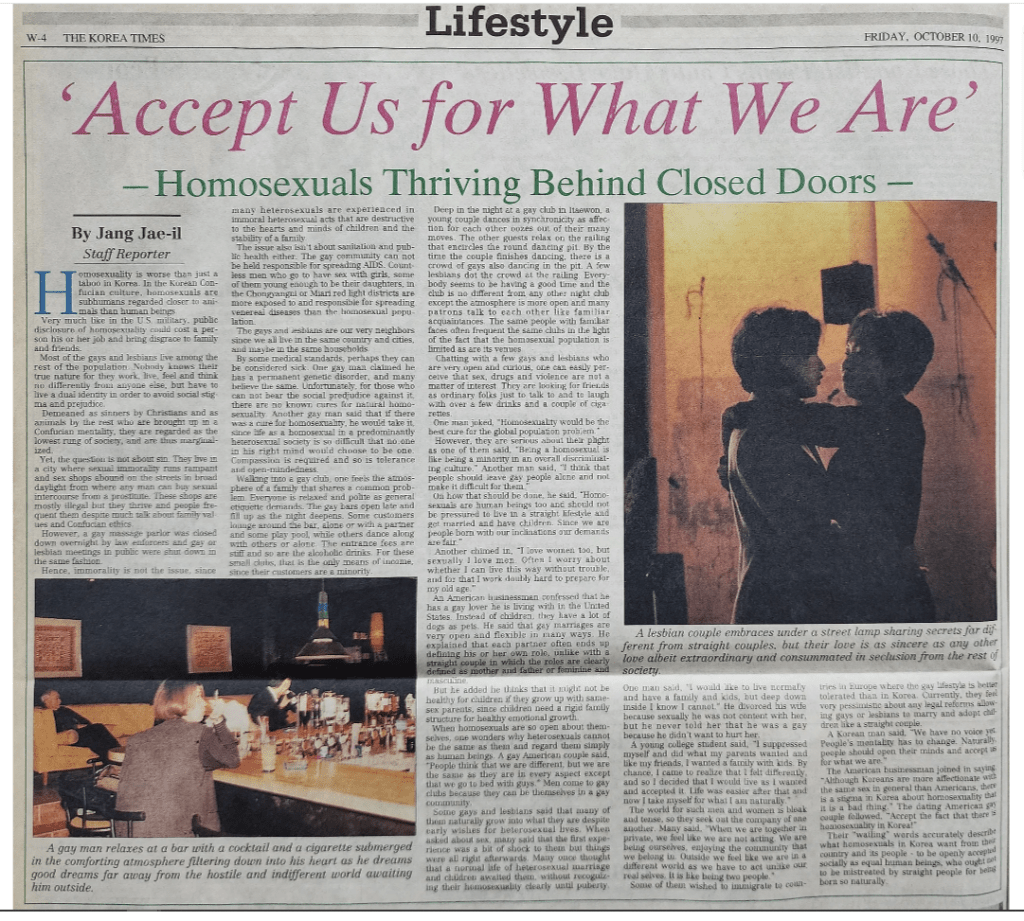
Kim, Y. and Hahn, S. (2006). Homosexuality in ancient and modern Korea. Culture, Health, and Sexuality, 8 (1, Jan – Feb 2006): pp. 59-65.
Keywords: Confucianism, history, representation, homosexuality, gay, male
In this essay, the authors attempt to root queerness in Korea with rhetoric within Confucianism to better understand how these historical narratives continue to shape contemporary practices of homophobia. The authors argue that “hwarang,” or the noble-born sons who became leaders of a military group in the Silla dynasty, had romantic relationships with one another as depicted in historical poetry and songs. In contrast to historically romantic notions of same-sex attraction, contemporary depiction of homosexuality in Korea describe it as deviant and dangerous despite growing representations in the media. In contrast to many Two-Spirit or Mahu people who are finding hope in reclaiming their queer histories that have been colonized, no Korean that I have interviewed mentions any queer connections to Korean history as a form of legitimacy.
King, B. (2008). “Being Gay Guy, That is the Advantage”: Queer Korean Language Learning and Identity Construction. Journal of Language, Identity, and Education, 7 (23): pp. 230-252.
Keywords: gay, male, language, space, oral history, interviews, ESL
In this study, King uses three Korean gay men to explore how heteronormativity informs second language acquisition. English language learning groups are extensive in Korea. Learning English provided queer Koreans with safer foreign communities with which to learn and communicate aspects of their queer identities. Because a couple of my interviewees have mentioned queerness in Korean language (for example, differences in pronouns, language differences with drag ball terminology, etc.), and several of my interviews focus on transnational queer spaces, the study provides context to my interviews two-fold.
Müller, A. (2022). From King Hyegong to Suh Dongjin: The evolution of LGBT and homosexual rights in the Korean community, according to historiographical texts. International Journal of Korean Humanities and Social Sciences, 8 (2022).
Keywords: history, gay rights, literature, gay, male, Confucianism, pride, protest, representation
The author analyzes representations of gender and sexuality in historical Korean texts embedded within Confucianism, and provides an overview of queer organizations in the 1990s. Key historical representations of homosexuality include connections to prostitution and theater, while contemporary terms like “second-class” and “sexual minority” prioritized by the Seoul Queer Culture Festival seek to problematize the marginalization of queer people within a broader heteronormative and deeply hierarchical society. Several of my interviews speak about their participation in or even leadership within the queer culture festival that continues to be politicized amidst broader religious homophobic backlash.
Rich, T. (2017). Religion and public perceptions of gays and lesbians in South Korea. Journal of Homosexuality, 64 (5): pp. 606-621.
Keywords: religion, representation, Conservative, Christianity, survey
Rich’s public opinion survey regarding public attitudes towards the gay and lesbian community in South Korea reveals that Protestants – particularly conservative Protestants – consistently showed higher levels of homophobic disapproval of same-sex relationships than other religions in Korea as well as those without religious identification. The findings are not ground-breaking but it does provide quantitative data to demonstrate the larger homophobic climate in South Korea. The study provides context for interviews with Koreans discussing religious conversion attempts as well as broader Korean disapproval of queer identities.
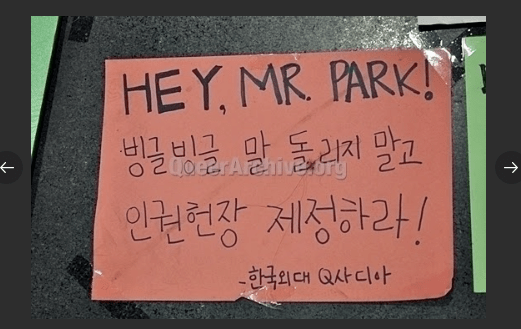
Queer Rock: Korean Queer Archive: https://queerarchive.org/
Keywords: archive, gender, sexuality, history, protest, artifact, memory
Completely in Korean, “Queer Rock” is a digital archive that includes more than 2000 artifacts related to queer life and history in Korea, including photographs, descriptions of non-digitized material (like more than 700 queer films), documents related to queer activism, queer literature, queer underground newspapers, and more. The digital archive also has an in-person archive for non-digitized material in Seoul. In light of a staunchly Conservative homophobic climate that generates a lot of negative information about queerness, the archive situates itself as a practice of activist scholarship in its goal to provide “correct knowledge and information to the public and to serve as a facilitator for faithful research by researchers.”

Various Interviews. We Who Feel Differently (Archive): https://wewhofeeldifferently.info/interviews.php.
Keywords: oral history, archive, interview, queer, gender, activism, organizing
We Who Feel Differently is a database documentary that addresses critical issues of contemporary queer culture. The archive includes Korean and English transnational with PDF and MP4 formats. While not specifically on Korea, the archive includes video interviews with several Koreans on LGBTQ+ topics in South Korea, including:
- Interview with Ruin, a trans Korean woman and activist
- Interview with Cheon Jae-Woo (Chorus Boy), a leader in the the activist organization Chingusai
- Interview with Choi Hyun-Sook and Mong Choi, activists who have been involved in founding the Sexual Minority Committee in Korea’s New Progressive Party, campaigning for sexual orientation to be added to the anti-discrimination act, and founding the Rainbow Action organization
- Interview with Hanmuji, a trans Korean who discusses their experience transitioning as well as how FTM trans people are largely erased within trans culture in Korea
Yi, H. and Gitzen, T. (2018). Sex/gender insecurities: trans bodies and the South Korean military. Transgender Studies Quarterly 5(3): 378–393.
Keywords: sex, gender, trans, institutions, policy, law, military
Yi and Gitzen explore the treatment of trans people within the South Korean military as part of mandatory military service, using trans bodies to illuminate the militarization of the sex/gender system within Korea. The authors argue, “While trans men are exempt from service because they are not considered able-bodied men, trans women pose a significant complication for the rigid military conscription system, given that most trans women in their early twenties – the time when most will be drafted into service – have yet to change their legal gender identification.” Because the gender binary as a key component of the country’s rigid sex/gender system, the authors argue that the trans body is a “material manifestation of the insecurities of a rigid sex/gender system perpetuated by a masculine and patriarchal military institution” (Yi and Gitzen, 2018). The study especially grounds my interviews with queer Koreans regarding their experience with intense homophobia serving in the military.
Phillips, J. and Yi, J. (2019). Queer communities and activism in South Korea: Periphery-center currents. Journal of Homosexuality.
Keywords: Seoul, Busan, place, identity, activism, religion, society
In this comparative study on queerness in Seoul and Busan, the authors argue that queer-identified people in Busan position their queerness as peripheral to queer centrality in Seoul. The authors argue that outside Seoul, LGBTQ+ people appear to acquiesce to homophobia through closeted identities. Regional activists sometimes express their activism as hierarchically less important than queer activism in Seoul. Because of greater homophobia outside of Seoul, the authors argue that queer people in the periphery often articulate stronger demands for equality and freedom from discrimination than those in Seoul. Finally, Seoul has the highest concentration of queer people who remain connected to the church, whereas in the periphery, LGBTQ+ people have little to no dialogue with opponents or participation in organized religion which has served as the country’s largest opponent of LGBTQ+ groups.
Yi, J. and Phillips, J. (2015). Paths of integration for sexual minorities in Korea. Pacific Affairs, 88 (1, March 2015), pp. 123-134.
Keywords: separatism, religion, Christianity, community
Yi and Phillips argue that, due to the prevailing model of queer people forming their own free and separate social enclaves to avoid homophobia from largely Christian opponents. Alternatively, however, a “bridging-dialogue” model has emerged in which individual LGBTQ+ people “nurture communicative social ties with members of the larger society in ostensibly non-political settings” (Yi and Phillips, 2015). The authors argue that although new, this model “attracts many more participants” than separatist identity politics and “generates dialogue and other social exchange among different groups, including conservative Christians and foreign-origin LGBTQ+ [people]” (Yi and Phillips, 2015).
Korea-specific sources for further inquiry:
ARTICLE Alexander, E. (2019). Chong-ro: A space of belonging for young gay men in Seoul. Boyhood Studies, 12 (2), pp. 11-28: doi: 10.3167/bhs.2019.120202.
EBOOK Barnard, I. (2020). Sex Panic Rhetorics: Queer Interventions. The University of Alabama Press.
ARTICLE Campbell, K. (June 10, 2011). [Pride in South Korea – Part II] Foreign residents diversify S. Korea’s queer culture scene. Hankyoreh: https://english.hani.co.kr/arti/english_edition/e_national/482151.html.
ARTICLE Dong-Jin, S. (2001). Mapping the Vicissitudes of Homosexuality in South Korea. Journal of Homosexuality, 40:3-4, 65-78.
THESIS Gitzen, T. (2018). The queer threat: National security, sexuality, and activism in South Korea. [PhD Dissertation, University of Minnesota].
ARTICLE Gitzen, T. (2022). Narratives of the homoerotic soldier: the fleshiness of the South Korean military. Cultural Studies 36 (6): 1005–1032.
HARDCOPY Gitzen, T. (2023). Banal security: queer Korea in the time of viruses. Helsinki University Press.
ARTICLE Kumar, N. (May 19, 2022). The queers are here. NOVAsia: https://novasiagsis.com/the-queers-are-here/.
ARTICLE Kwon, J. (2016). Commodifying the Gay Body: Globalization, the Film Industry, and Female Prosumers in the Contemporary Korean Mediascape. International Journal of Communication 10 (2016), 1563-1580.
THESIS Lee, B. (2018). A study on urban economy and sub-culture in the urban area: A case study on Itaewon. [Master’s thesis: Seoul National University].
EBOOK Lee, J. (2010). Service Economies: Militarism, Sex Work, and Migrant Labor in South Korea. University of Minnesota Press.
EBOOK Lim, J. and Browne, K. (2007). Geographies of Sexualities: Theories, Practices, and Politics. Routledge.
ARTICLE Mckinnon, S., Robinson, S., & Reynolds, R. (2020). “I could tell I wasn’t like everybody else”: Toward a History of Queer Childhoods in Australia. Journal of the History of Childhood and Youth, 13(2), 268–287.
EBOOK Moon, S., Adams, J., and Steinmetz, G. (2005). Militarized Modernity and Gendered Citizenship in South Korea. Duke University Press.
CHAPTER Park, J. (2010). Representation, politics, ethics: Rethinking homosexuality in contemporary Korean cinema and discourses. Chapter in AsiaPacifiQueer: Rethinking genders and sexualities, Eds. Martin, F., Jackson, F., McLelland, M., and Yue, A. University of Illinois Press.
ARTICLE Park-Kim, S., Lee-Kim, S., NS Kwon-lee, E. (2008). The lesbian rights movement and feminism in South Korea. Journal of Lesbian Studies 10 (3-4), pp. 161-190:
HARDCOPY Shin, G. and Chang, P. Eds. (2011). South Korean Social Movements: From Democracy to Civil Society. Routledge.
ARTICLE Wei, H. (2023). Rethinking Queer (Asian) Studies: Geopolitics, Covid-19, and Post-Covid queer theories and mobilities. Journal of Homosexuality.
ARTICLE Yang, Sungeun. (2021). Young generation’s perception of same-sex sexuality and attitudes toward same-sex marriage in South Korea. Original Research, July-September 2021.
ARTICLE Youn, G. (2018). Attitudinal Changes toward Homosexuality during the past two decades (1994-2014) in Korea. Journal of Homosexuality, 65:1, 100-116.
 The People's Archive