We have compiled a list of texts focused on oral/public history methods, specifically in terms of gender & sexuality history. These texts have been made available as part of the GNDR 4690 course. If you are an author here and would like us to remove your embedded link, please let me know!
Methods of Queer Public/Oral History:
Bly, L. and Wooten, K. (2012). Make your own history: Documenting feminist and queer activism in the 21st century. Litwin Books.
This collection offers case studies of archival work as forms of social justice activism, particularly focusing on queer and feminist movement organizing archives. These examples demonstrate how the place and practice of activism has shifted from a physical headquarters of strategizing to a multiplicity of methods and fronts, including DIY, anarchist, and digital activism. This collection explores ways in which archivists are shifting their methods to document the dissonance of these movements while making sure that activists are not rendered invisible. Taken together, the collection discusses the practical material challenges of documenting archiving contemporary activism, archival theories, sub-culture formation, digitization as well as analog cultural productions, and creative/cultural activism.
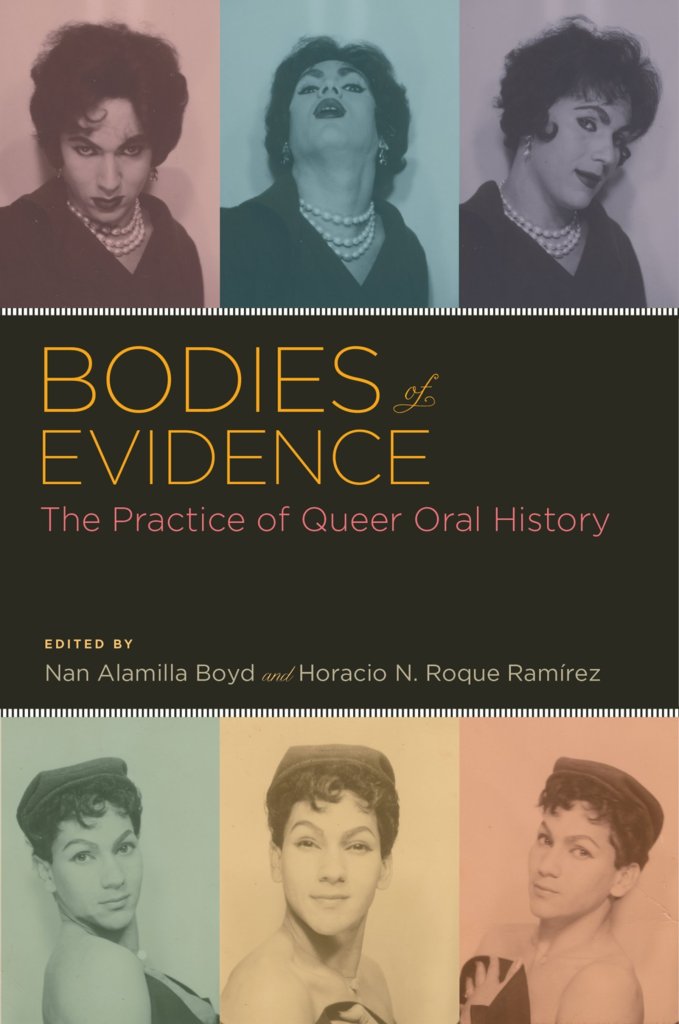
Boyd, N. & Roque Ramírez, H. N. (2012). Bodies of evidence: the practice of queer oral history. Oxford University Press.
Brown. E. (2015). Trans/Feminist Oral History. TSQ : Transgender Studies Quarterly, 2(4), 666–672.
Frazier, N. and Mayotte, C. (November 30, 2021). Social Justice Oral History Workshop. Oral History Association: https://youtu.be/6AR1W5336nY.
In this workshop, Razier and Mayotte explore how oral history interviewing can serve as a practice of social justice by centering the interviewee and their communities. The workshop presents a “best practices” guide by featuring sample models, questions to consider, and supplemental materials for workshop participants to apply to their own oral history projects.
Marcus, E. (Ongoing). Making Gay History: LGBTQ Oral Histories from the Archive. Podcast: https://podcasts.apple.com/us/podcast/making-gay-history-lgbtq-oral-histories-from-the-archive/id1162447122.
Making Gay History is a podcast series that features historic interviews with queer people with little editing. This is an excellent model for my work in that it is a collection of oral history interviews (roughly 40-60 minutes each) recorded by Eric Marcus with a wide range of queer people since the 1970s and 1980s. The episodes are conversational, focusing on allowing the interviewee to speak about whatever they’d like to discuss regarding their queerness at the time. Marcus has dozens of recordings, some even with famous queer icons like Sylvia Rivera before they were well-known in the queer liberation movement.
Menjivar, M. (April 4, 2023). Workshop: Activating Oral Histories. Oral History Association: https://bit.ly/3UHPujL.
Menjivar presents various methods of participatory engagement with oral history, particularly looking at the ways in which public exhibition can incorporate collaboration as a tool of “activating” oral histories.
Queering the Map. (Ongoing). Website: https://www.queeringthemap.com/
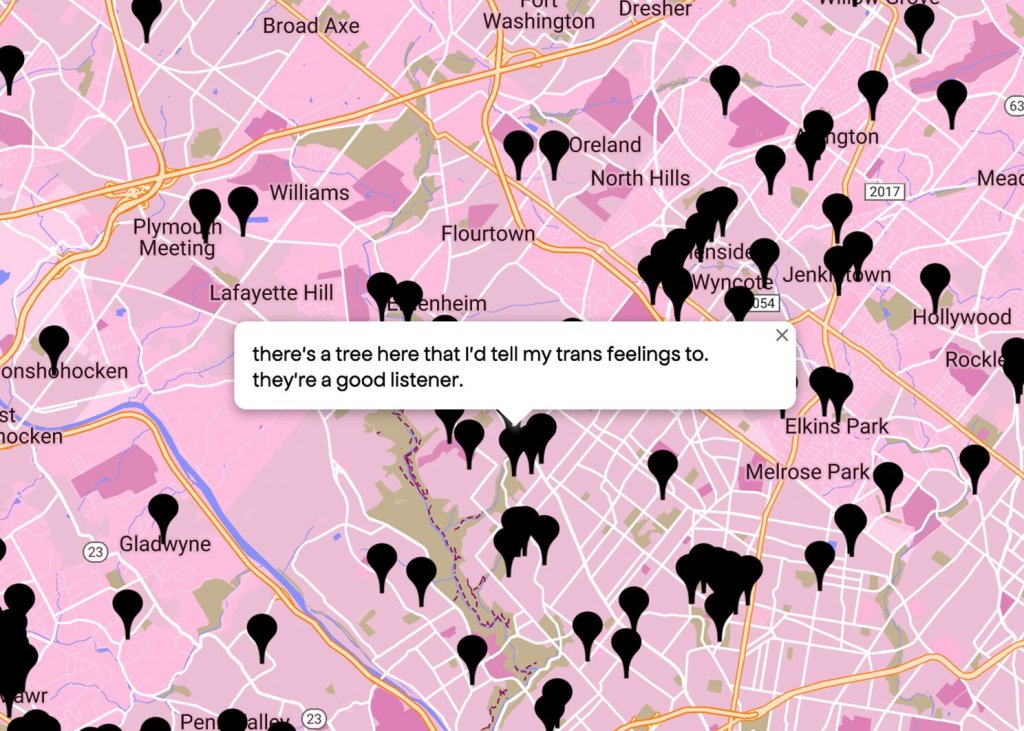
Oung, J. (June 25, 2023). Just made a queer memory? Drop a pin. New York Times: https://www.nytimes.com/2023/06/25/style/queering-the-map-lucas-larochelle.html [U1]
This interactive public history project is a crowd-sourced digital atlas that allows anyone in the world to place a pin on a map and describe a queer moment that happened in that place. Queer moments could include secret romances, coming out, breaking up, or sexy episodes. As covered by the New York Times, the point of the project is to tell personal stories of LGBTQ+ experiences rather than typical public history sites like Stonewall Inn or Emily Dickinson’s home. The map serves as a digital archive of places where LGBTQ+ people have experienced community, rejection, survival, and joy that serve as radical reactions against societal homophobia and transphobia. According to the creator, the project’s popularity is a “testament to the ‘absolutely lifesaving’ potential of digital platforms like Queering the Map, which can provide LGBTQ people with comfort and solidarity that can be difficult to find in the real world” (Oung, 2023).
Oral History Association. (n.d.). Best Practices. The Oral History Association: https://oralhistory.org/best-practices/
This guide offers tips on preparing for an interview (including obtaining informed consent, articulating the procedure, and composing preliminary questions), tips when interviewing (including negotiating the conversation with the interviewee), and preserving the interview in ways that enhance accessibility.
Shopes, L. (August 2012). Linda Shopes: Web guides to doing oral history. Oral History in the Digital Age: http://ohda.matrix.msu.edu/featured-resources/shopes-web-guides/.
Although a bit outdated, this website serves as a collection of digital resources on conducting oral history interviews, including Shopes’ own perspectives on these sites’ strengths and weaknesses. While many sources of conducting oral history interviews focus on question-formation or interviewer/interviewee dynamics, this list centers the digitization of oral history interviews while also featuring sites that discuss the ethical and interpretive issues embedded within the process of oral history interviewing.
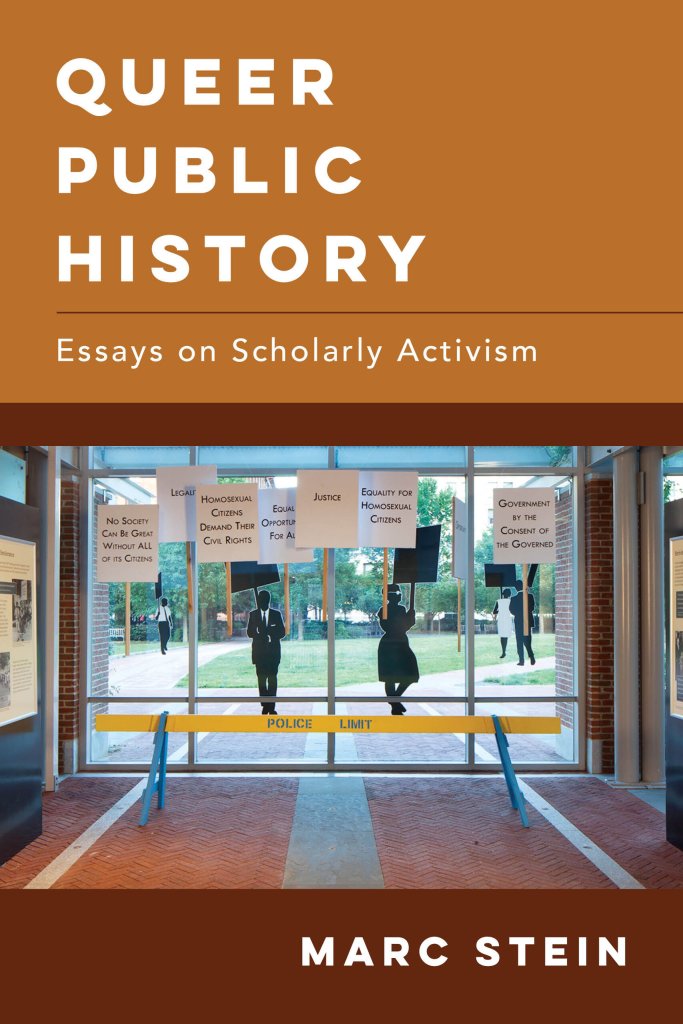
Stein, M. (2022). Queer public history: Essays on scholarly activism. University of California Press.
This collection of essays explores different case studies of activist scholarship/scholarly activism on queer history, tracing the evolution of “queer historical interventions in the academic sphere and explor[ing] the development of publicly oriented queer historical scholarship” over the past three decades. The collection covers a wide array of topics, including: memories, “disciplines, publish, and protest” (Stein, 2022), activism, immigration, the Supreme Court, exhibitions, and the popularity of Stonewall. Of particular interest is the introduction’s discussion of how public historians “queered” public history (as a method rather than an “add diversity and stir” mentality) by blending scholarly research, with personal narratives and activism.
Wyker, C. (2020). Dissonance and multiplicity in queer oral history narratives. The Oral History Review, 47 (1), 93-103.
Wyker argues that the problem of historiocity (or historical authenticity) exists when the interviewee does not have a queer past – according to the author, a point of contention in queer historiography as to whether the subject can speak as a queer narrator. Because this dissonance and multiplicity of queer subjecthood is a problem unique to queer oral history, the author argues that queer oral history serves a unique purpose in challenging paradigms of identity and traditional historical methodologies not in spite of but *because* of its unstable historical subjects. Wyker, therefore, argues that this fluid subjectivity requires further inquiry into the relationship between history, memory, and identity. Wyker concludes by asking groundbreaking questions, such as: “Does authenticity come from lived experience of self-definition? And How do the dual environments of virtual space and real world complicate how we understand historical authenticity?
Further Research
EBOOK Hamilton, P. and Shopes, L., Eds. (2008). Oral History and Public Memories. Temple University Press.
EBOOK Johnson, P. (2018). Black. Queer. Southern. Women: An Oral History. The University of North Carolina Press.
ARTICLE Murphy, K., Pierce, J., and Ruiz, J. (2016). What makes queer oral history different. The Oral History Review, 43 (1), p. 1-24.
EBOOK Summerskill, C., Murphy, A., and Vickers, E. (2022). New Directions in Queer Oral History: Archives of Disruption. Taylor and Frances.
 The People's Archive